Key Takeaways
- A token priced under $1 is not automatically cheap supply size determines market value, not the per-coin price.
- FET, VIRTUAL and GRT are the leading AI tokens trading below $1 in mid-2026, all with live products.
- The broader AI crypto category sits near $21 billion in total market cap, with roughly $2.87 billion flowing in during one week of June 2026.
- Low cap AI tokens offer higher upside but also higher volatility, dilution and liquidity risk.
- Decentralised compute and autonomous AI agents remain the dominant narratives driving the sector.
Which crypto to buy below $1?
There is no single answer. Among AI tokens, FET, VIRTUAL and GRT are the most established names currently under $1, each backed by working products and listings on major exchanges such as Binance, Coinbase and Kraken.
Cheaper, lower-cap tokens exist but carry sharply higher risk. Always research utility, supply and liquidity before buying.
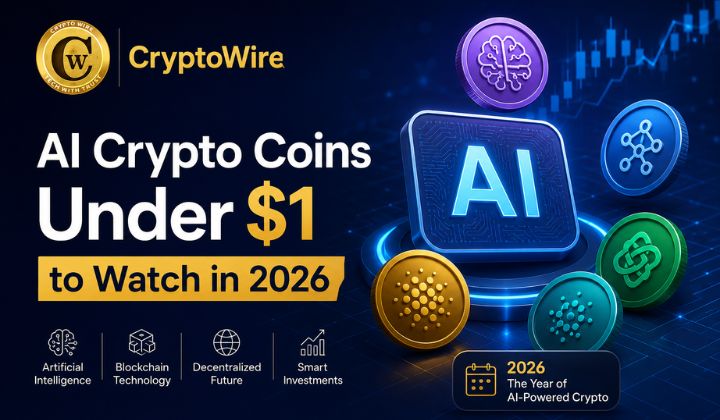
AI crypto coins under $1 are low-priced tokens that power blockchain-based artificial intelligence decentralised compute, data networks, and autonomous AI agents.
As of June 2026, popular examples trading below a dollar include Artificial Superintelligence Alliance (FET) near $0.18, Virtuals Protocol (VIRTUAL) around $0.60, and The Graph (GRT) close to $0.02.
A low unit price does not equal a bargain utility and tokenomics matter far more.
What Are AI Crypto Coins Under $1?
AI crypto coins are tokens tied to projects that combine blockchain with artificial intelligence. Their value is meant to track real network usage GPU jobs processed, datasets queried, or AI agents deployed.
Under $1 only describes the per-token price. Because some tokens have billions of units in supply, a $0.02 coin can hold a larger market cap than a $0.60 one. Compare market capitalisation, not headline price.
Why Cheap AI Crypto Coins Attract Investors
Sub-dollar tokens feel accessible, and percentage gains can look dramatic during AI hype cycles.
The sector also has real demand: centralised AI compute is expensive and concentrated, and decentralised networks pitch an open alternative.
But the same low price that promises upside also reflects past drawdowns FET and GRT both trade more than 90% below their all-time highs.
Best AI Crypto Coins Under $1 in 2026
The table compares three of the most widely held AI tokens currently under $1. Prices and market caps are approximate and change constantly.
Token | Price (approx.) | Market Cap | Core Use Case |
Artificial Superintelligence Alliance (FET) | $0.18 | ~$0.45B | Autonomous AI agents and decentralised AI research |
Virtuals Protocol (VIRTUAL) | $0.60 | ~$0.40B | Launchpad for tokenised AI agents on Base and Solana |
The Graph (GRT) | $0.02 | ~$0.22B | Data indexing layer making on-chain data AI-readable |
FET (ASI Alliance) merges Fetch.ai and SingularityNET, led by Humayun Sheikh and AGI researcher Ben Goertzel, and builds infrastructure for autonomous agentic commerce.
VIRTUAL runs an AI-agent launchpad on Coinbase’s Base network and Solana with a buyback-and-burn model.
GRT powers The Graph, a data-indexing layer that has processed over 1.2 trillion queries and now serves on-chain data to AI agents.
Which Crypto to Buy Below $1?
This is the most common search query, and the honest answer is that it depends on your research and risk tolerance.
Established AI tokens like FET, VIRTUAL and GRT offer working products and deep liquidity. Smaller, newer tokens may promise larger gains but fail more often.
Checking GitHub activity, token unlock schedules and real usage matters more than the price tag. This is information, not investment advice.
What Are the Risks of Low Cap AI Tokens?
AI token prices are highly volatile and often overshoot in both directions. Low cap tokens carry thin liquidity, so large trades move the price sharply.
Other risks include token unlocks that dilute holder, projects that ship narratives instead of products, smart-contract bugs, and competition from well-funded centralised AI firms.
Regulatory uncertainty adds another layer.
Diversification and position sizing are standard ways investors manage these risks.
Future Outlook
The convergence of AI and crypto is now one of the market’s most-watched sectors, with DePIN compute networks, agent economies and data markets maturing into live products.
Institutional interest is growing spot ETF filings for Bittensor’s TAO and rising on-chain revenue point to deeper adoption.
Whether today’s sub-dollar tokens recover depends on real usage replacing speculative volume. No outcome is guaranteed, and the sector remains early and cyclical.
Frequently Asked Questions
Are AI crypto coins under $1 a good investment?
They can offer upside but are high-risk. A low price reflects market valuation, not guaranteed value.
Which AI crypto is the cheapest with real utility?
Among established names, The Graph (GRT) trades near $0.02 with clear data-indexing utility, though low price reflects high supply.
Can a coin under $1 reach $100?
For high-supply tokens it is mathematically unlikely, as that implies an extreme market cap. Always check supply first.
Where can I buy AI crypto coins under $1?
Major exchanges such as Binance, Coinbase, Kraken and CoinDCX list leading AI tokens. Confirm the official contract address before trading.
What makes a token an AI crypto gem?
Usually, a low cap token with real usage and active development but gem status is speculative, not a fact.
Is low price the same as cheap?
No. A $0.02 coin with huge supply can be worth more than a $0.60 coin. Compare market cap, not unit price.
What Investors Should Watch Next
- On-chain usage metrics query volumes, agent transactions and GPU jobs versus pure trading volume.
- Tokens unlock and emission schedules that could add selling pressure.
- Regulatory developments such as US digital-asset market structure bills.
- Institutional signals like ETF filings and enterprise integrations.
Stay informed with the latest trends in Crypto market, Web3, blockchain innovation, and cybersecurity updates at CryptoWire.
Disclaimer: This article is for informational and educational purposes only and is not investment advice. Cryptocurrency is volatile and high-risk. Always do your own research and consult a qualified financial professional before investing.