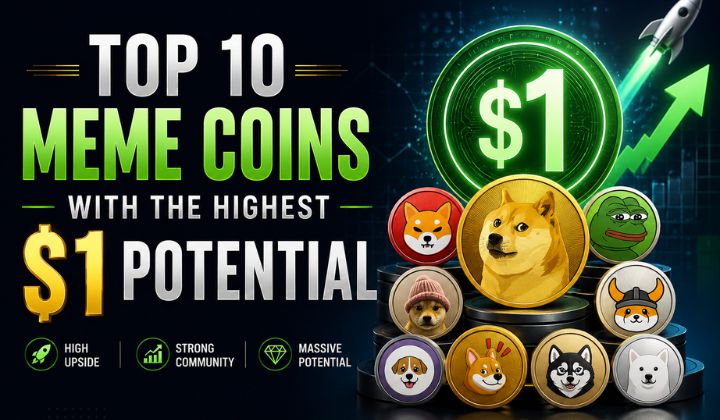
10 Meme Coins That Could Reach $1 Before 2030
Only meme coins with low token supplies can realistically reach $1.
As of June 2026, the structurally credible candidates are low-supply tokens like Dogwifhat (WIF) and Fartcoin, with Dogecoin (DOGE) a distant, harder maybe.
Coins such as Shiba Inu, Pepe, Bonk and Floki cannot hit $1 their trillions of tokens would demand a market cap larger than the entire global economy.
The $1 question is really a supply question.
Quick Answer
A meme coin’s price equals its market cap divided by its circulating supply.
For a token to reach $1, its market cap must equal its supply in dollars.
So a coin with 1 billion tokens needs a $1 billion market cap to reach $1 achievable.
A coin with 589 trillion tokens needs a $589 trillion market cap impossible. That single rule sorts every meme coin on this list.
Key Takeaways
- Supply decides everything: $1 is mathematically realistic only for coins with roughly 1 billion tokens or fewer.
- WIF and Fartcoin are the closest structural candidates, each with ~1 billion supply and prices already in the $0.15–$0.30 range.
- Dogecoin needs ~$170 billion to reach $1 nearly double its 2021 peak market cap of $88.8 billion.
- Shiba Inu, Pepe and Bonk cannot reach $1; the required market caps exceed all the wealth on Earth.
- Total meme coin market cap sits near $34.7 billion in June 2026 a volatile, sentiment-driven sector.
- None of this is investment advice. Meme coins can lose 80–95% of value in bear phases.
What Does Reaching $1 Actually Mean for a Meme Coin?
A coin’s price is market capitalization divided by tokens in circulation.
Two coins can hold identical billion-dollar valuations while one trades at $1 and the other at $0.000001 the only difference is how many tokens exist.
So a low unit price does not make a coin cheap, and a sub-cent token reaching $1 is often a mathematical impossibility, not a 100x story.
Before chasing any next coin to hit $1, ask one question: how many tokens are in circulation?
10 Meme Coins and Their Real Odds of Reaching $1
Below is the comparison that matters most price, supply, and the market cap each token would need to trade at $1.
Meme Coin | Price (Jun 2026) | Circulating Supply | Market Cap Needed for $1 | $1 Realistic? |
Dogwifhat (WIF) | ~$0.16 | ~1 billion | ~$1 billion | Structurally yes |
Fartcoin (FARTCOIN) | ~$0.30 | ~1 billion | ~$1 billion | Structurally yes |
Dogecoin (DOGE) | ~$0.10–0.15 | ~170 billion (rising) | ~$170 billion | Very difficult |
Pudgy Penguins (PENGU) | ~$0.006 | ~63 billion | ~$63 billion | Very unlikely |
Shiba Inu (SHIB) | ~$0.000009 | ~589 trillion | ~$589 trillion | Effectively impossible |
Pepe (PEPE) | <$0.00001 | trillions | hundreds of $ trillions | Effectively impossible |
Bonk (BONK) | <$0.0001 | tens of trillions | tens of $ trillions | Effectively impossible |
Prices and supply figures are approximate, sourced from CoinGecko and CoinMarketCap, June 2026. Crypto data changes constantly.
Tier 1: Structurally Realistic Candidates
- Dogwifhat (WIF) the strongest case. This Solana meme coin has ~1 billion fully circulating tokens and already hit an all-time high of $4.82 in March 2024. At ~$0.16 today, $1 implies roughly a $1 billion market cap a level it has cleared before. WIF has no utility by design and trades on Binance, Coinbase and Kraken, living on community momentum.
- Fartcoin (FARTCOIN) a credible long shot. With ~1 billion tokens and a price near $0.30, Fartcoin sits closer to $1 in unit terms than almost any major meme coin. The path is purely speculative, but the arithmetic does not block it.
- Popcat (POPCAT) low-supply Solana play. Popcat’s sub-1-billion supply puts it in the same structural category as WIF. A move to $1 still needs a large valuation jump, but it is not ruled out by mathematics.
Tier 2: The Borderline Case
- Dogecoin (DOGE) the most famous $1 dream. DOGE has the liquidity, the brand and real institutional tailwinds a U.S. SEC/CFTC digital-commodity classification in March 2026 and live spot ETFs. But it carries ~170 billion tokens with no cap, minting ~5 billion new DOGE a year. Reaching $1 means a ~$170 billion market cap, well above its 2021 peak near $88.8 billion. Galaxy Digital’s Alex Thorn has floated DOGE at $1 on a $100 billion cap, yet rising supply works against holders every year.
Tier 3: Famous but Mathematically Out of Reach
- Shiba Inu (SHIB). With ~589 trillion tokens, $1 would mean a $589 trillion market cap — more than all the wealth on Earth combined. SHIB’s burns and Shibarium Layer-2 are real, but they remove a tiny fraction of supply. Targeting $0.01, let alone $1, is unrealistic.
- Pepe (PEPE). Trillions of tokens place $1 hundreds of trillions of dollars out of reach. PEPE is a momentum trade, not a $1 candidate.
- Bonk (BONK). The leading Solana meme coin has tens of trillions of tokens and 350+ ecosystem integrations, yet $1 remains arithmetically impossible.
- Floki (FLOKI), 9. Pudgy Penguins (PENGU), 10. Mog Coin (MOG). All three carry supplies far too large for $1. PENGU, at ~63 billion tokens and ~$0.006, would need a ~$63 billion market cap among the largest in all of crypto just to reach $1.
Why Most Meme Coins Cannot Reach $1
The pattern is clear the coins people most want to see at $1 are the ones least able to get there.
Huge supplies were often a deliberate marketing choice a low unit price feels accessible to new buyers. That same design makes $1 a fantasy. Burn programs grab headlines, but burning a few trillion tokens out of hundreds of trillions barely moves the math.
What Are the Risks?
- Extreme volatility: meme coins routinely swing 20–50% in days and can fall 80–95% in bear cycles.
- No fundamentals: most have no revenue, cash flow or asset backing price is pure sentiment.
- Exchange and compliance risk: tokens can be flagged or delisted; WIF received a Binance monitoring tag in March 2026.
- Concentration risk: a few large wallets can move thinly traded coins sharply.
Future Outlook
Meme coins remain a temperature check on speculative appetite. If a broad risk-on rally returns, low-supply names like WIF, Fartcoin and Popcat hold the cleanest structural path toward $1.
Dogecoin’s ETF and commodity status give it the strongest institutional story, even if supply makes $1 a steep climb. Trillion-supply tokens may still post large percentage gains but not a $1 price tag.
Frequently Asked Questions (FAQ)
Which meme coin is most likely to reach $1?
On supply math alone, Dogwifhat (WIF) has the clearest path, having already traded above $1 in 2024.
Can Shiba Inu reach $1?
No. At 589 trillion tokens, $1 would require a market cap larger than the global economy.
Will Dogecoin ever hit $1?
It is possible but difficult; DOGE needs roughly a $170 billion market cap and faces ongoing supply inflation.
Why do meme coins have such high supplies?
A low unit price feels affordable to new buyers, which aids early marketing but it caps realistic price ceilings.
Are meme coins a good investment?
They are high-risk, speculative assets. Many investors limit them to a small share of a portfolio and define an exit before buying.
Where can I track these prices?
CoinGecko and CoinMarketCap list live prices, supply and market cap for every coin above.
What Investors Should Watch Next
- Circulating supply first: check token count before believing any “road to $1” claim.
- Dogecoin ETF flows and whether institutional demand can absorb its annual supply growth.
- Solana meme momentum for WIF, Fartcoin and Popcat, the most supply-efficient candidates.
- Exchange compliance tags that signal liquidity or delisting risk.
- Overall market sentiment, since meme coins amplify both rallies and crashes.
Stay informed with the latest trends in Crypto market, Web3, blockchain innovation, and cybersecurity updates at CryptoWire.
Disclaimer
This article is for informational and educational purposes only and does not constitute investment, financial or trading advice. Cryptocurrency markets are highly volatile, and meme coins are among the riskiest assets in the sector. Prices and supply data are approximate and subject to rapid change. Always do your own research and consult a qualified financial professional before investing. Never invest more than you can afford to lose.