Spot vs Futures Trading in Crypto: Key Differences, Risks and What Traders Should Know
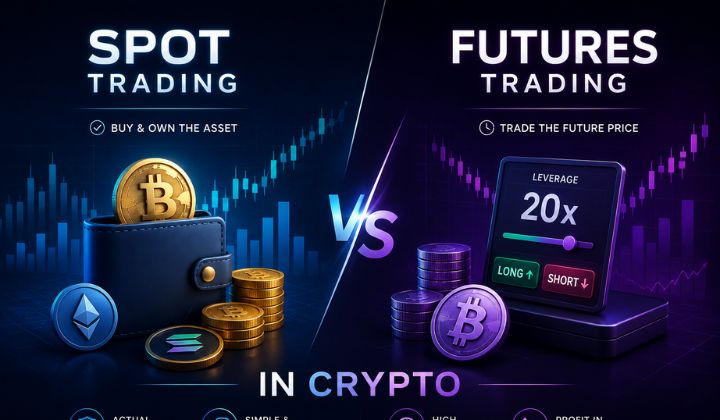
Spot trading means buying or selling a cryptocurrency at its current market price with immediate ownership of the asset. Futures trading involves contracts that track an asset’s price, allowing traders to use leverage and profit from both rising and falling markets without owning the coin.
Spot suits long-term investors seeking simplicity, while futures suit experienced traders who can manage leverage and liquidation risk.
Quick Answer
Spot trading gives you direct ownership of crypto with no leverage and no liquidation risk. Futures trading offers leveraged exposure through contracts, higher profit potential and the ability to short, but carries the risk of losing your entire margin. Beginners typically start with spot; futures demand strict risk management.
Key Takeaways
- Spot trading transfers full ownership of the asset; futures trading only creates contractual price exposure.
- Futures dominate crypto markets: derivatives accounted for roughly $18.6 trillion of the $20.5 trillion traded in Q1 2026, versus about $1.9 trillion in spot.
- Leverage in futures can amplify gains but also triggers forced liquidations during volatile moves.
- Spot trading is simpler, has no expiry and works best for long-term accumulation.
- Perpetual futures, a crypto-native contract with no expiry date, make up the largest share of derivatives volume.
What Is Spot Trading in Crypto?
Spot trading is the direct purchase or sale of a cryptocurrency at its current market price.
When you buy 1 ETH on an exchange such as Binance, Coinbase or an Indian platform like CoinDCX, the coin is credited to your account and can be withdrawn to a private wallet.
Ownership is the defining feature you control the asset, can hold it indefinitely and face no liquidation risk. Profits come only when the price rises.
What Is Futures Trading in Crypto?
Futures trading uses contracts whose value is derived from an underlying asset like Bitcoin or Ethereum. Traders never own the coin; they hold a position that settles in stablecoins or fiat based on price movement.
Crypto exchanges popularised perpetual futures, contracts with no expiry that stay anchored to spot prices through funding payments between longs and shorts.
Futures allow leverage, often 5x to 100x, and let traders short falling markets or hedge existing holdings.
Spot vs Futures Trading: Comparison Table
Feature | Spot Trading | Futures Trading |
Ownership | Full ownership of the asset | Contract only, no asset ownership |
Leverage | None (1:1 exposure) | Typically 5x to 100x |
Profit direction | Only when prices rise | Long and short positions |
Liquidation risk | None | High; positions can be wiped out |
Expiry | None | Fixed expiry or perpetual contracts |
Best suited for | Long-term holders, beginners | Experienced traders, hedgers |
Why the Difference Matters in 2026
Derivatives dominate crypto activity. CoinGlass data for Q1 2026 shows about $20.5 trillion in total volume, with roughly $18.6 trillion from derivatives and $1.9 trillion from spot, a ratio near 9.6 to 1.
Binance held around 35% of derivatives share, while decentralised platforms such as Hyperliquid, dYdX and GMX pushed on-chain futures mainstream.
Since leveraged positioning drives most short-term swings, even spot investors benefit from watching funding rates and open interest.
What Are the Risks?
Futures Risks
Leverage compresses timelines a small adverse move can liquidate an entire position, and cascading liquidations can erase billions in hours. Funding costs also erode returns over time.
Spot Risks
Spot traders face market drawdowns, exchange counterparty risk and self-custody mistakes, but they can never lose more than their invested capital and can wait out downturns.
What Should Investors Know Before Choosing?
Choose spot for ownership, simplicity and a long-term horizon. Choose futures only if you understand margin, position sizing and stop-losses.
In India, crypto gains are taxed at 30% with 1% TDS on transfers, so factor taxes into any strategy. Neither approach guarantees profits, and this is not investment advice.
FAQ
Is spot trading safer than futures trading?
Generally yes. Spot has no leverage or liquidation, so losses are limited to the amount invested.
Can I lose more than I invest in futures?
On most crypto exchanges, losses are capped at your margin because positions are force-liquidated, but you can lose that entire margin quickly.
What are perpetual futures?
Futures contracts with no expiry date that track spot prices through funding payments exchanged between longs and shorts.
Which is better for beginners?
Spot trading. It is simpler, and mistakes are less costly without leverage.
Why is futures volume so much higher than spot?
Leverage multiplies notional volume, and traders use futures for hedging and short-term speculation, inflating turnover relative to spot.
Do futures prices affect spot prices?
Yes. Large liquidations and funding imbalances in futures markets frequently drive short-term spot price moves.
What Investors Should Watch Next
Track the derivatives-to-spot volume ratio, funding rates and open interest as signals of market leverage.
Watch the growth of decentralised perpetuals platforms like Hyperliquid, regulatory moves on leverage limits in major markets including India, and whether spot volumes recover from their 2026 lows, a sign of genuine capital inflows rather than leveraged churn.
Stay informed with the latest trends in Crypto market, Web3, blockchain innovation, and cybersecurity updates at CryptoWire.
Disclaimer: This article is for informational and educational purposes only and is not investment advice. Cryptocurrency is volatile and high-risk. Always do your own research and consult a qualified financial professional before investing.