AI Agents in Crypto: How Autonomous Agents Are Reshaping Web3 in 2026
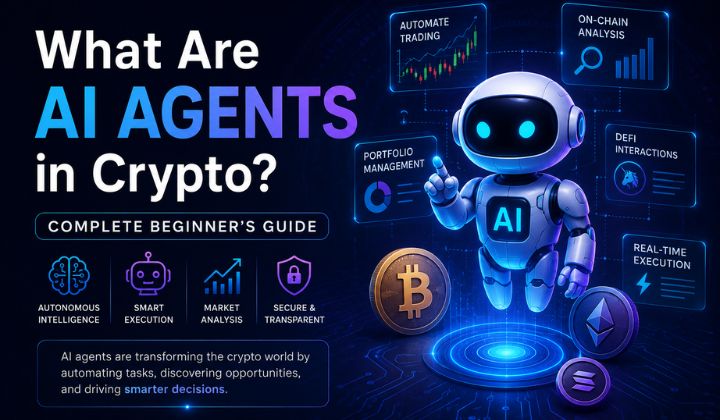
AI agents in crypto are autonomous software programs that read on-chain data, reason through market conditions and execute transactions trading, staking, bridging on user’s behalf.
In 2026, they have moved from a speculative narrative to working infrastructure, with the AI crypto sector’s market capitalization roughly tripling from about $9 billion in early 2025 to an estimated $22.6–27 billion by mid-2026.
Quick Answer
Crypto AI agents combine large language models with wallets, on-chain data and smart contracts to automate research and execution. Unlike rule-based bots, they adapt strategies in real time.
Leading ecosystems include Bittensor (TAO), the ASI Alliance, Virtuals Protocol and Olas, while spot TAO ETF filings by Grayscale and Bitwise signal growing institutional interest.
Key Takeaways
- The AI crypto sector grew from roughly $9 billion (early 2025) to $22.6–27 billion by May 2026, despite a 16% Q1 correction.
- Agents have shifted from analysis to execution: agent wallets, intent-based trading and cross-chain routing are now live.
- Virtuals Protocol reported 23,500+ active wallets and about $479 million in AI-driven on-chain activity through March 2026.
- Grayscale and Bitwise filed for spot Bittensor (TAO) ETFs in April 2026 — a potential institutional gateway.
- Risks remain high: most 2024–25 agent tokens lost 80–95% of peak value, and agent security exploits are rising.
What Are AI Agents in Crypto?
An AI agent is software that can interpret instructions, access tools and data, reason through a task, and take action.
In crypto, that means an agent can monitor DeFi yields, track whale wallets, prepare limit orders, and with permission execute swaps or bridge assets across chains.
Traditional bots run on fixed conditional logic; agents process price feeds, on-chain flows and social sentiment simultaneously and adjust strategy on the fly.
Why AI Agents Matter for Web3 in 2026
Crypto is a natural settlement layer for autonomous software. A bank account cannot be opened by an AI, but a crypto wallet can be created in milliseconds.
Stablecoins offer 24/7 settlement and smart contracts allow programmable execution the raw ingredients for machine-to-machine commerce.
Exchanges are responding: OKX upgraded its OnchainOS developer platform in March 2026 to support autonomous trading agents across 60+ chains, and institutional research increasingly favors multi-agent frameworks over single-model analysis.
Leading AI Agent Crypto Categories
Category | What It Does | Examples |
Agent infrastructure | Decentralized compute and model networks powering agents | Bittensor (TAO), Render (RENDER) |
Agent launch platforms | Create, tokenize and deploy autonomous agents | Virtuals Protocol (VIRTUAL), Olas (OLAS) |
Data and oracles | Feed verified market and event data to agents | Chainlink (LINK), The Graph (GRT) |
Alliance ecosystems | Merged AI networks for agents, marketplaces, data | ASI Alliance (FET/ASI) |
Current Market Relevance
The sector’s Q1 2026 correction acted as a purge rather than a collapse.
Tokens with AI agent branding but no product were largely wiped out, while infrastructure projects with measurable usage Bittensors subnet revenues, Virtuals Protocol’s wallet growth, and intent-solver networks that processed about $4.1 billion in cross-chain volume over 90 days retained capital.
ETF filings for TAO could, if approved, open a regulated pipeline between traditional finance and AI-native tokens.
What Are the Risks?
Extreme volatility: the late-2024 agent-token boom saw hundreds of weekly launches; the majority later lost 80–95% of value.
AI-washing: many projects use AI branding without a functional product or genuine token utility.
Security: compromised agent memory and insecure tool connections have already caused losses in 2026; execution infrastructure matters as much as the agent.
Token unlocks and liquidity: large scheduled unlocks and thin liquidity can amplify drawdowns in smaller agent tokens.
Future Outlook
The direction of travel is toward agents as everyday market co-pilots reading data, comparing yields and executing approved transactions around the clock.
Agentic payments machines transacting with machines via stablecoins remain early, with commercial activity still limited relative to the narrative.
The signal to track through H2 2026 is usage, not price protocol revenue, active agent wallets and verified cross-chain volume.
Frequently Asked Questions
What is an AI agent in crypto?
An AI agent is software that can understand a goal, read on-chain and market data, reason through options, and act for example rebalancing a DeFi position or routing a swap across chains — with or without human approval at each step.
How are AI agents different from trading bots?
Bots follow fixed if-then rules. Agents process live price feeds, on-chain flows and sentiment together, adapt strategy as conditions change, and can execute multi-step workflows such as bridging and swapping in one task.
Which are the top AI agent crypto projects?
Bittensor (TAO), the ASI Alliance (Fetch.ai, SingularityNET, Ocean Protocol), Virtuals Protocol, Olas, Render and Chainlink appear consistently across 2026 sector rankings.
Are AI agent tokens a good investment?
The sector is volatile. Many 2024–25 agent tokens lost 80–95% of peak value. Verifiable usage — revenue, active wallets, transaction volume — is the key filter. This article is not investment advice.
What is ‘AI-washing’?
Projects that attach an AI label without a functional product. If a token isn’t required for the AI to work, or the project is only a thin wrapper over a centralized API, treat the branding with caution.
Can AI agents hold crypto wallets?
Yes. Unlike bank accounts, crypto wallets can be created programmatically, which is why agents increasingly use stablecoins and smart contracts for autonomous, machine-to-machine payments.
What Investors Should Watch Next
- The SEC’s decision timeline on the Grayscale and Bitwise spot TAO ETF filings.
- Quarterly on-chain revenue from Bittensor subnets and Virtuals Protocol wallet growth.
- Adoption of agent wallet standards and intent-based execution by major exchanges.
- Security incidents tied to agent memory and tool connections — a maturing sector’s stress test.
- Regulatory clarity on stablecoins, the settlement layer for agentic payments.