What Is a Honeypot Token? How the Buy-Only Crypto Trap Works
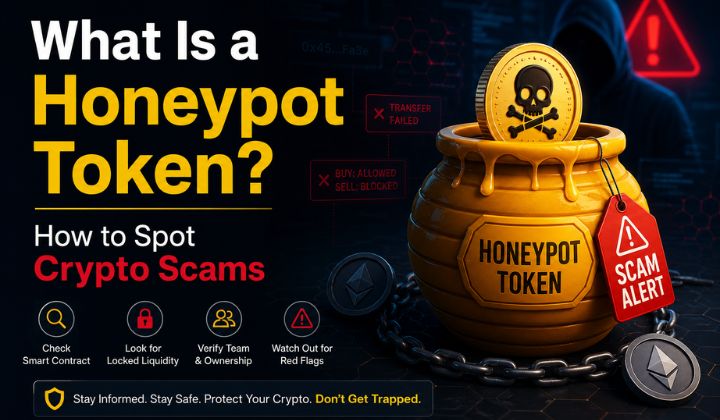
A honeypot token is a fraudulent cryptocurrency whose smart contract lets investors buy but silently blocks them from selling.
The token looks tradable on decentralized exchanges such as Uniswap or PancakeSwap, often with a chart that only climbs.
Once purchased, the coins are worthless because the contract code prevents any exit, trapping funds permanently on chain.
Quick Answer
Honeypot token: a scam token with hidden sell restrictions coded into its smart contract. Buyers can enter but never exit. Losses are irreversible because blockchain transactions cannot be undone, and only the scammer’s whitelisted wallets are allowed to sell.
Key Takeaways
- Honeypot tokens allow buying but block selling through blacklists, whitelists, or extreme sell taxes hidden in the contract.
- Security firm CertiK traced one group that deployed 979 honeypot contracts on BNB Smart Chain in just two months.
- Crypto hacks, exploits, and scams cost investors more than $3.4 billion in 2025, with honeypots a recurring category.
- ‘Honeypot-as-a-service’ kits now let non-technical scammers launch malicious tokens in minutes.
- Free scanners such as Token Sniffer, Honeypot.is, and GoPlus, plus a small test sell, can flag most traps before you commit funds.
What Is a Honeypot Token in Crypto?
In cybersecurity, a honeypot is a decoy system built to study hackers. In crypto, the term is flipped the trap targets investors.
A scammer writes a token contract on Ethereum, BNB Smart Chain, or Solana with a hidden condition, typically a blacklist that reverts every sell transaction, a whitelist that permits sales only from the deployer’s wallets, or a sell tax approaching 100%.
To a beginner, think of it as a shop where the entrance works but every exit door is welded shut.
The 2021 Squid Game token remains the best-known example: buyers watched the price rocket while their own sell orders quietly failed, until the creators cashed out.
Why Honeypot Tokens Matter for Investors
Honeypots exploit the openness of decentralized finance. Anyone can list a token on a DEX with no vetting, and meme-coin mania supplies a steady stream of buyers chasing early entries on Dexscreener or DEXTools.
Hacken documented a single scammer who ran at least nine linked honeypots in February 2024, stealing roughly $3.2 million with help from paid promoters on Telegram.
Because the theft happens at the contract level, no exchange or wallet provider can reverse it.
Honeypot Token vs Rug Pull: Key Differences
Aspect | Honeypot Token | Rug Pull |
How it traps funds | Contract code blocks selling; buying works normally | Developers drain the liquidity pool |
Warning signs | Only-green price charts, zero sell transactions | Unlocked liquidity, concentrated holdings |
When loss occurs | The moment you buy | When liquidity is withdrawn |
Detection | Contract scanners, test sells with small amounts | Liquidity lock checks, holder analysis |
Current Market Relevance in 2026
The threat is industrialising. Researchers report that 2026-era honeypots increasingly use contract obfuscation, code that looks clean at launch and activates sell-blocking only after liquidity and volume build, defeating many automated scanners.
Ready-made honeypot kits sold on Telegram lower the skill barrier further, and low-fee chains like BNB Smart Chain and Solana remain the most common launchpads because deploying hundreds of tokens costs almost nothing.
What Are the Risks of Honeypot Tokens?
The core risk is total, unrecoverable loss: once funds enter the liquidity pair, the contract itself enforces the block.
Secondary risks include dust-token attacks, where unsolicited tokens sent to your wallet bait you into approving a malicious contract, and reputational damage to the wider DeFi ecosystem, which fuels regulatory scrutiny.
Individual losses are often small, but at scale they compound CertiK estimated one two-month cluster of 979 contracts netted scammers tens of thousands of dollars.
How to Detect a Honeypot Token
- Run the contract address through Token Sniffer, Honeypot.is, De.Fi Scanner, or GoPlus Security before buying.
- Check the chart and explorer (Etherscan, BscScan): a token with buys but zero successful sells is a near-certain trap.
- Verify liquidity locks, audits from firms like CertiK, SlowMist, or Hacken, and a non-anonymous team.
- Test with a tiny buy and attempt an immediate sell before sizing up.
Future Outlook
Expect an arms race. Scanners and DEX screeners are adding behavioural detection, while scammers respond with delayed-activation contracts and AI-generated marketing.
Exchanges and security firms are tightening listing checks, but in permissionless markets the first line of defence will remain investor due diligence.
FAQ: Honeypot Tokens
What is a honeypot token in simple terms?
It is a scam coin you can buy but never sell, because the code forbids it.
Can I recover money lost to a honeypot?
Almost never. Blockchain transactions are irreversible, though you should document details and report the contract to explorers and communities.
Are honeypots the same as rug pulls?
No. A rug pull drains liquidity; a honeypot blocks your sell. Both leave tokens worthless.
Which tools check for honeypot tokens?
Token Sniffer, Honeypot.is, GoPlus Security, De.Fi Scanner, and manual review on Etherscan or BscScan.
Why do honeypot charts only go up?
Because no victim can sell, there is no sell pressure; scammers also wash-trade to fake momentum.
Are audited tokens always safe?
No. Audits reduce risk but obfuscated or upgradeable contracts can turn malicious after review.
What Investors Should Watch Next
Watch for the spread of honeypot-as-a-service kits, the shift toward delayed-activation contracts that evade scanners, and how DEX platforms respond with built-in risk labels.
Regulatory attention on token launch standards, and improved real-time detection from firms like CertiK and Hacken, will shape how survivable the meme-coin frontier remains.
This article is for education only and is not investment advice.
Stay informed with the latest trends in Crypto market, Web3, blockchain innovation, and cybersecurity updates at CryptoWire.