
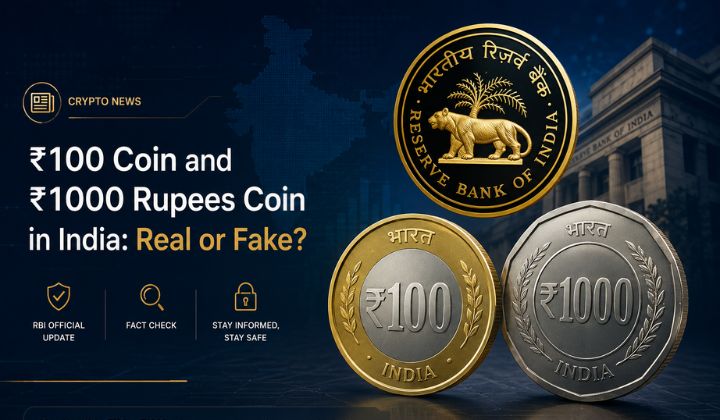
₹100 Coin and ₹1000 Rupees Coin in India: Real or Fake, Value & Legal Tender (2026 Guide)
Yes, both the ₹100 coin and the ₹1000 rupees coin are real in India but only as commemorative, non-circulating coins issued by the Government of India under the Coinage Act, 2011.
They are legal tender up to ₹1,000 per transaction, yet they are minted for collectors and special occasions, not for everyday spending.
Key Takeaways
- The 100 rs coin is real but circulates only as a commemorative coin (e.g., the 2018 Atal Bihari Vajpayee coin), not as pocket change.
- The 1000 rupees coin in India is also real first issued in 2010 to mark 1,000 years of the Brihadeeswarar Temple, and again in 2025 for Emperor Rajendra Chola I.
- Under the Coinage Act, 2011, ₹1,000 is the highest coin denomination India can legally mint.
- Both denominations are legal tender but capped at ₹1,000 per transaction (Section 6), and shops are not obliged to accept them.
- Viral WhatsApp claims of a new ₹1000 coin as regular currency are false repeatedly debunked by fact-checkers.
- Resale value is driven by silver content, rarity, mintage and condition (UNC/Proof), not by face value.
Quick Comparison: 100 Rs Coin vs 1000 Rs Coin
Feature | ₹100 Coin | ₹1000 Coin |
Status | Commemorative | Commemorative |
In daily circulation? | No | No |
Legal tender? | Yes (up to ₹1,000/txn) | Yes (up to ₹1,000/txn) |
Typical metal | Cupro-nickel or silver alloy | Silver (high purity) |
First/landmark issue | Yoga Day (2015), Vajpayee (2018) | Brihadeeswarar Temple (2010) |
Who issues it | Govt. of India via SPMCIL mints | Govt. of India via SPMCIL mints |
Main audience | Collectors, gifting | Collectors, investors |
Sources: Reserve Bank of India; Coinage Act, 2011; India Government Mint (SPMCIL).
What Are the ₹100 and ₹1000 Coins in India?
Commemorative coins are special-edition coins struck to honour a person, institution or historic milestone.
They are produced in limited numbers and are not meant for general circulation, unlike the ₹1, ₹2, ₹5, ₹10 and ₹20 coins you use daily.
The right to mint coins rests solely with the Government of India under the Coinage Act, 2011, with coins struck at the four India Government Mints in Mumbai, Kolkata, Hyderabad and Noida and issued through the Reserve Bank of India (RBI).
The 100 Rs Coin Explained
The 100 Rs coin is a commemorative coin issued for national events, anniversaries and eminent personalities.
Its obverse carries the Lion Capital of Ashoka with Satyameva Jayate and the denomination, while the reverse changes with each theme.
Most are struck in cupro-nickel premium collector editions contain silver. For example, the commemorative ₹100 coin honouring actor-politician N. T. Rama Rao (NTR) was priced at roughly ₹4,160 and composed of 50% silver, 40% copper, 5% nickel and 5% zinc a clear sign that the metal, not the face value, sets the price.
- International Day of Yoga — ₹100 coin, 2015
- Atal Bihari Vajpayee — ₹100 coin released in 2018 in memory of the former Prime Minister
- Karpoori Thakur, Mohammed Rafi, University of Lucknow, Operation Shakti among many later ₹100 themes
The 1000 Rupees Coin in India Explained
The 1000 rupees coin in India is the highest denomination coin the country can legally mint ₹1,000 is the ceiling set by the Coinage Act, 2011. It has been issued only as a silver commemorative coin on rare, landmark occasions:
- Brihadeeswarar Temple (2010): struck to mark 1,000 years of the temple in Thanjavur, Tamil Nadu, built by Raja Raja Chola I and completed in 1010 AD. It was India’s first-ever ₹1,000 coin.
- Rajendra Chola I (2025): on 27 July 2025, the Prime Minister unveiled a second ₹1,000 commemorative coin marking 1,000 years of the naval expedition of Emperor Rajendra Chola I, at Gangaikonda Cholapuram, Tamil Nadu.
Is the 1000 Rupees Coin Real in India?
Yes, but with an important caveat. A 1000 rs coin genuinely exists, yet only as a commemorative collector’s coin. What is false is the recurring viral claim circulated on WhatsApp and social media, especially around the 2016 demonetisation that the RBI has launched a new ₹1,000 coin as everyday currency.
Fact-checking outlets including BOOM, Factly, The Quint and News Nation have repeatedly debunked these messages.
FACT CHECK
Claim: RBI has launched a new ₹1000 coin for daily use.
Verdict: FALSE. The only ₹1,000 coins are commemorative issues (2010 and 2025). The RBI confirms that coins in active circulation are 50 paise, ₹1, ₹2, ₹5, ₹10 and ₹20 only.
The 2016 demonetisation affected banknotes not coins.
Are ₹100- and ₹1000-Coins Legal Tender in India?
Technically, yes. The Coinage Act, 2011 defines coin to include commemorative coins, so every officially issued ₹100 and ₹1000 coin is legal tender.
However, Section 6 places a practical ceiling on how coins can be used.
THE LAW COINAGE ACT, 2011 (SECTION 6)
A coin of any denomination not lower than ₹1 is legal tender for any sum not exceeding one thousand rupees per transaction.
In effect, no person is obliged to accept coins in payment of more than ₹1,000 in a single transaction.
This is why these coins are valid money in law but rarely usable in practice a single ₹1,000 coin already hits the per-transaction cap, and most shopkeepers will not recognise or accept it.
They fall into the category collectors call Non-Circulating Legal Tender (NCLT) legally valid, but not designed for the open market.
What Is the Value of a 100 Rs Coin Today, and How Much Is a 1000 Rs Coin Worth?
The value of a 100 rs coin today and how much a 1000 rs coin is worth depending far more on numismatic and metal factors than on face value.
A silver ₹1,000 coin can trade well above ₹1,000 because of its silver content alone a common cupro-nickel ₹100 coin may sit close to its issue price.
Four factors drive the price:
Value Driver | Why It Matters |
Metal content | Silver coins carry intrinsic bullion value that rises with silver prices; cupro-nickel coins do not. |
Rarity & mintage | Lower mintage and discontinued themes command higher premiums. |
Condition / grade | Uncirculated (UNC) and Proof coins in original mint packaging fetch the most. |
Demand & theme | Coins tied to popular figures or events (temples, leaders, anniversaries) attract more collectors. |
Note: Coin valuations fluctuate with silver prices and collector demand. Treat any quoted figure as indicative, and obtain an independent appraisal before buying or selling.
Timeline: India’s High-Value Commemorative Coins
Year | Milestone |
1964 | India’s first commemorative coin honours Jawaharlal Nehru. |
2010 | First ₹1,000 coin 1,000 years of the Brihadeeswarar Temple, Thanjavur. |
2011 | Coinage Act, 2011 caps the maximum coin denomination at ₹1,000. |
2015 | ₹100 coin issued for the International Day of Yoga. |
2018 | ₹100 coin released in memory of Atal Bihari Vajpayee. |
2025 | Second ₹1,000 coin unveiled for Emperor Rajendra Chola I’s naval expedition. |
Where Can I Sell a 100 or 1000 Rupees Coin?
If you own one of these coins, you generally have better luck with the collector market than with a bank counter.
Common avenues to sell a 100 or 1000 rupees coin include:
- Numismatic marketplaces: platforms such as CoinBazaar, Sikkaji, CollectorBazar and Indian Coin Mill list and sell Indian commemorative coins.
- Collector communities: sites like Numista help you identify a coin, gauge rarity and connect with collectors for exchange.
- General marketplaces: eBay, OLX and Amazon listings exist, though buyer trust and authentication vary.
- Local coin dealers and auctions: useful for higher-value silver pieces that benefit from professional grading.
BUYER & SELLER CAUTION
Counterfeits and overhyped rare listings are common. Verify authenticity, prefer coins in original mint packaging, and check seller reputation.
New commemorative coins can be bought directly from the India Government Mint (SPMCIL). Selling antiquities over 100 years old may require permission from the Archaeological Survey of India.
Why It Matters: Benefits, Risks and Impact
Benefits
- Cultural and historical record each coin documents a national milestone or icon.
- Tangible store of value in silver editions, partly hedged against inflation.
- Gifting and legacy appeal for weddings, anniversaries and collections.
Risks
- Misinformation viral new coin hoaxes cause shops to wrongly refuse valid coins.
- Liquidity high face value plus the ₹1,000 cap makes day-to-day use impractical.
- Fraud fake commemorative coins and inflated valuations target inexperienced buyers.
Impact
As India’s economy shifts toward UPI and digital payments, demand for high-denomination physical currency in transactions keeps falling.
Yet commemorative coin issuance continues precisely because its purpose is cultural and collectible rather than transactional a niche that sits comfortably alongside a cashless mainstream.
Future Outlook
Expect more not fewer high-value commemoratives. The 2025 Rajendra Chola I ₹1,000 coin signals continued government appetite for landmark issues tied to heritage and anniversaries.
With ₹1,000 fixed as the legal ceiling under the Coinage Act, 2011, the ₹1000 rupees coin will remain a rarefied collector and investor instrument, while ₹100 coins broaden as a flexible canvas for honouring people and events.
For ordinary payments, however, the digital rupee and UPI not coins define India’s future.
Frequently Asked Questions (FAQs)
Is the 1000 rupees coin real in India?
Yes. India has issued real ₹1,000 commemorative coins in 2010 for the Brihadeeswarar Temple and in 2025 for Emperor Rajendra Chola I. They are genuine and legal tender, but they are collector coins, not everyday currency. Claims of a “new ₹1000 coin for daily use” are false.
What is the value of a 100 rs coin today?
It depends on metal, rarity and condition. A common cupro-nickel ₹100 coin sits near its issue price, while silver editions are worth more for instance, a silver-bearing ₹100 NTR coin was priced around ₹4,160. UNC and Proof coins in original packaging command the highest premiums.
How much is a 1000 rs coin worth?
A ₹1,000 commemorative coin is typically silver, so it’s worth is tied to silver content plus collector demand and can exceed ₹1,000. Exact value varies with rarity, mintage, condition and the silver market, so an independent appraisal is recommended before any sale.
Where can I sell a 100 or 1000 rupees coin?
Through numismatic marketplaces (CoinBazaar, Sikkaji, CollectorBazar, Indian Coin Mill), collector communities such as Numista, local coin dealers and auctions, or general platforms like eBay and OLX. Always verify authenticity and seller reputation and prefer coins in original mint packaging.
Are ₹100 and ₹1000 coins legal tender in India?
Yes, both are legal tender under the Coinage Act, 2011, which includes commemorative coins. However, Section 6 limits coin payments to ₹1,000 per transaction, and shops are not obliged to accept them so they function as Non-Circulating Legal Tender rather than spendable money.
Stay informed with the latest trends in Crypto market, Web3, blockchain innovation, and cybersecurity updates at CryptoWire.
Authoritative Sources
- Reserve Bank of India — Coins (issuance & circulation) — https://www.rbi.org.in/Scripts/ic_coins.aspx
- The Coinage Act, 2011 — India Code (full text) — https://www.indiacode.nic.in/handle/123456789/2112
- Coins of the Indian Rupee — Wikipedia (history & denominations) — https://en.wikipedia.org/wiki/Coins_of_the_Indian_rupee
- India Government Mint / SPMCIL — Commemorative Coins — https://www.indiagovtmint.in/commemorative-coins/
- BOOM — Fact check on ₹20, ₹100, ₹150, ₹1000 coins — https://www.boomlive.in/did-rbi-issue-rs-20-rs-150-rs-100-rs-1000-coins-a-factcheck
- FACTLY — ₹100/₹150/₹20 commemorative coins fact check — https://factly.in/rbi-has-not-launched-rs-5000-currency-note-and-these-rs-150-rs-100-rs-20-coins-are-not-legal-tender/
- Numista — ₹1000 Rajendra Chola I coin (2025) entry — https://en.numista.com/478137