
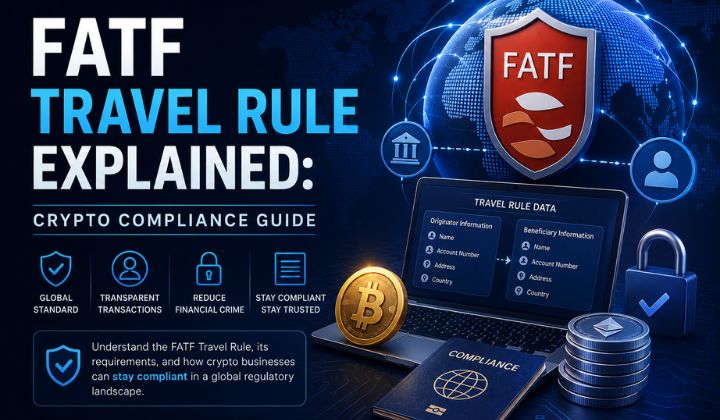
FATF Travel Rule Explained: What It Means for Crypto Users and Exchanges in 2026
The FATF Travel Rule requires crypto exchanges and other Virtual Asset Service Providers (VASPs) to collect, verify, and share sender and receiver information for crypto transfers, similar to bank wire transfer rules.
Introduced under FATF Recommendation 16 in 2019, it is now law in 85 of 117 assessed jurisdictions, including India, where FIU-IND enforces it with no minimum transaction threshold.
Quick Answer
The Travel Rule makes identity data travel with every qualifying crypto transaction. When you move crypto between exchanges, the sending platform must transmit your name, wallet address, and other details to the receiving platform before or during the transfer.
In India, all FIU-registered exchanges such as CoinDCX, CoinSwitch, and ZebPay must comply for transfers of any size.
Key Takeaways
- The Travel Rule is the application of FATF Recommendation 16 to virtual assets, extended to crypto in June 2019.
- 85 of 117 jurisdictions had passed Travel Rule legislation by mid-2025, up 31% from 65 in 2024.
- India applies the rule with no minimum threshold, stricter than the $1,000 standard used in many countries.
- FIU-IND’s updated AML/CFT guidelines (January 8, 2026) tightened Travel Rule norms, with added scrutiny on unhosted wallets and P2P transfers.
- Enforcement remains uneven: roughly 59% of jurisdictions with legislation have taken no supervisory action yet.
What is the FATF Travel Rule?
The Financial Action Task Force (FATF) is the global anti-money laundering standard-setter.
Its Travel Rule obliges VASPs, meaning exchanges, custodial wallet providers, and brokers, to collect and transmit originator (sender) and beneficiary (receiver) information alongside crypto transfers.
The data typically includes the sender’s full name, wallet address, and physical address, exchanged off chain between platforms using standards like IVMS101 and networks such as Notabene, Sygna, and TRP.
For beginners: think of it as the crypto version of a bank wire transfer form. The blockchain records the transaction, but the Travel Rule attaches verified identities to it, allowing regulators to trace suspicious flows.
Why the Travel Rule Matters in 2026
The rule has moved from paper to practice. The EU’s Transfer of Funds Regulation applies a zero threshold on every crypto transfer between service providers, and the US, UK, Singapore, and Japan run active enforcement regimes.
FATF’s June 2025 update underscored the stakes, citing North Korea’s $1.46 billion Bybit theft, the largest crypto hack in history, of which only 3.8% was recovered. Stablecoins like USDT and USDC are explicitly in scope.
Travel Rule Thresholds: Global Comparison
Jurisdiction | Travel Rule Threshold | Key Detail |
India (FIU-IND) | No minimum threshold | Applies to all VDA transfers; updated guidelines issued January 8, 2026 |
European Union (TFR) | Zero threshold | Full data on every CASP-to-CASP transfer since December 30, 2024 |
United States (FinCEN) | $3,000 | A lower $250 cross-border threshold remains under proposal |
United Kingdom (FCA) | £1,000 domestic / zero cross-border | Active enforcement regime |
Japan (JVCEA) | No minimum threshold | Applies to all crypto transactions |
India’s Travel Rule Framework Under FIU-IND
India brought crypto platforms under the Prevention of Money Laundering Act (PMLA) in March 2023, classifying them as reporting entities.
As of FY 2024-25, 49 exchanges were FIU-registered, including 45 domestic platforms.
The January 2026 guidelines raised the bar further mandatory CERT-In cybersecurity audits, live selfie KYC, six-monthly re-KYC for high-risk users, and new filings such as VTRs and FTRs.
Where Travel Rule vendors are unavailable, user self-declaration is permitted as limited relief.
Enforcement is real, with Binance paying Rs 18.82 crore and Bybit Rs 9.27 crore in penalties, and notices issued to over 25 offshore platforms.
What Are the Risks and Challenges?
Compliance brings friction. Interoperability between different Travel Rule messaging systems remains patchy, creating the sunrise issue where a compliant exchange transacts with counterparties in jurisdictions that have not yet enforced the rule.
Data privacy is another concern, as identity information now moves between platforms globally.
Privacy coins like Monero face delistings because their obfuscation defeats traceability and unhosted wallet transfers attract enhanced verification, including proof of wallet ownership.
What Should Investors Know?
For Indian users, the practical impact is straightforward expect KYC on every platform, provide counterparty details for withdrawals, and prove ownership when moving funds to a self-custody wallet.
Using FIU-registered exchanges is the only compliant route, and transaction data now feeds directly into tax enforcement alongside the 1% TDS regime.
FAQs
1. What is the FATF Travel Rule in crypto?
It requires crypto service providers to collect and share verified sender and receiver information with counterparty platforms during transfers, under FATF Recommendation 16.
2. Does the Travel Rule apply to all cryptocurrencies?
Yes. Bitcoin, Ethereum, stablecoins, and tokenized assets are all in scope, regardless of blockchain.
3. What is India’s Travel Rule threshold?
There is no minimum threshold. Every VDA transfer through an Indian exchange requires originator and beneficiary data.
4. Does the rule apply to self-custody wallets?
Exchanges must still collect information on transfers to or from unhosted wallets, which FIU-IND treats as high risk, and may require proof of ownership.
5. Are P2P transfers covered?
Pure peer-to-peer transfers with no intermediary generally fall outside the rule, but Indian exchanges must apply enhanced controls to P2P activity and may restrict it.
6. Who enforces the Travel Rule in India?
FIU-IND, under the Ministry of Finance, enforces it through the PMLA framework, with penalties under Section 13 for non-compliance.
What Investors Should Watch Next
Watch FATF’s next targeted update on enforcement gaps, FinCEN’s pending proposal to cut the US cross-border threshold to $250, and how strictly FIU-IND supervises the January 2026 guidelines through FY 2026-27.
India’s eventual comprehensive crypto framework, expected to build on SEBI and Ministry of Finance consultations, will likely deepen rather than dilute Travel Rule obligations. Compliance maturity, not regulatory escape, is now the direction of travel.
This article is for informational purposes only and does not constitute investment or legal advice.
Stay informed with the latest trends in Crypto market, Web3, blockchain innovation, and cybersecurity updates at CryptoWire.