Meme Coin vs Utility Token: Key Differences Every Crypto Investor Should Know
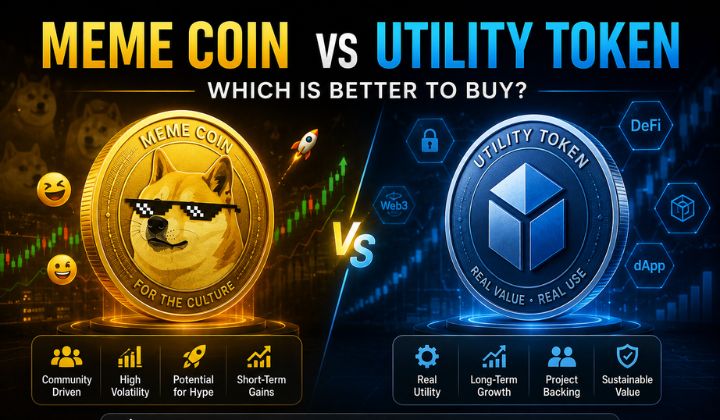
A meme coin is a cryptocurrency built around internet culture and community hype, with little or no built-in function, while a utility token gives holders access to a specific product or service on a blockchain network.
Meme coins like Dogecoin trade almost entirely on sentiment; utility tokens like Ethereum or Chainlink derive value from real usage. The difference shapes both risk and long-term potential.
Quick Answer
Meme coins = culture-driven, speculative assets with extreme volatility.
Utility tokens = function-driven assets tied to a working blockchain product. Meme coins can deliver fast gains but carry rug-pull and hype-collapse risk.
Utility tokens tend to be steadier because demand comes from network activity, not just social media momentum.
Key Takeaways
- Meme coins derive value from community sentiment; utility tokens derive value from real use cases like gas fees, oracles, or storage.
- The meme coin sector rallied over 30% in early 2026, topping $47 billion in market cap before cooling to roughly $24–35 billion by mid-year.
- Dogecoin, Shiba Inu, Pepe, and Bonk lead the meme category Ethereum, Chainlink, and Filecoin are classic utility tokens.
- Institutional interest is blurring the line Canary Capital filed for the first spot PEPE ETF in April 2026.
- Meme coins carry higher rug-pull and volatility risk; utility tokens face execution and competition risk.
What Is a Meme Coin?
A meme coin is a token inspired by internet jokes, viral trends, or pop culture. Dogecoin (DOGE), created in 2013 by Billy Markus and Jackson Palmer, started the category.
Shiba Inu (SHIB) on Ethereum, Pepe (PEPE), and Solana-based Bonk (BONK) followed.
Most meme coins lack a technical roadmap; their price is powered by community engagement, influencer attention, and speculative trading on platforms like Pump.fun.
What Is a Utility Token?
A utility token performs a job inside a blockchain ecosystem. Ether (ETH) pays for transactions on Ethereum.
Chainlink (LINK) pays node operators who feed real-world data to smart contracts. Filecoin (FIL) buys decentralised storage.
Because demand is linked to actual network usage, utility tokens have measurable fundamentals active addresses, fees generated, and developer activity that investors can analyse.
Meme Coin vs Utility Token: Side-by-Side Comparison
Factor | Meme Coin | Utility Token |
Core value driver | Community hype, virality, social sentiment | Real function within a blockchain platform |
Examples | Dogecoin (DOGE), Shiba Inu (SHIB), Pepe (PEPE), Bonk (BONK) | Ethereum (ETH), Chainlink (LINK), Filecoin (FIL), Polygon (POL) |
Volatility | Extreme prices swing on memes and influencer posts | High, but tied more to adoption and usage metrics |
Fundamentals | Usually none often no whitepaper or roadmap | Whitepaper, developer team, measurable on-chain demand |
Risk profile | Very high rug pulls and pump-and-dump schemes common | Moderate to high project execution and competition risk |
Best suited for | Short-term speculation with money you can afford to lose | Longer-term exposure to blockchain adoption |
Why the Difference Matters in 2026
The meme sector opened 2026 with a sharp rally total market cap jumped from about $38 billion to over $47 billion in the first week of January, with Pepe surging 65% before retracing to the $24–35 billion range by mid-year.
Meanwhile, daily Solana launchpad volumes crossed $180 million in January, showing how quickly speculative capital rotates.
Utility tokens, by contrast, track slower adoption curves: DeFi activity, real-world asset tokenisation, and enterprise blockchain usage.
Some projects now straddle both worlds Shiba Inu built the Shibarium ecosystem, and Floki expanded into gaming and NFTs, adding utility to meme-born tokens.
What Are the Risks?
Meme coins face rug pulls, anonymous founders, concentrated whale holdings, and hype cycles that can erase 80–90% of value within weeks. Nearly 45,000 new tokens launched in a single day on Solana in January 2026 most will fail.
Utility tokens are not risk-free either projects can lose to competitors, miss roadmap targets, or face regulatory scrutiny. Diversification and position sizing matter for both.
FAQs
1. Is Dogecoin a utility token?
No. Dogecoin is a meme coin, though it is accepted for payments by some merchants, including Tesla’s merchandise store.
2. Can a meme coin become a utility token?
Partially. Shiba Inu and Floki have added ecosystems, DEXs, and gaming but their prices still trade largely on sentiment.
3. Which is safer: meme coins or utility tokens?
Utility tokens are generally less risky because value is tied to usage, but no crypto asset is safe from volatility.
4. Are meme coins legal in India?
Yes, trading is legal on registered exchanges, with a 30% tax on gains plus 1% TDS applying to all crypto assets.
5. How do I identify a utility token?
Check for a whitepaper, an identifiable team, a working product, and on-chain demand for the token’s function.
6. Do meme coins have a future?
Likely yes as a speculative asset class institutional filings like the spot PEPE ETF suggest the category is maturing, but individual tokens remain high-risk.
What Investors Should Watch Next
Track the outcome of the spot PEPE ETF filing, whale accumulation in Dogecoin, Solana launchpad activity as a gauge of speculative appetite, and whether meme projects like Shibarium generate genuine on-chain usage. For utility tokens, watch fee revenue, developer activity, and real-world asset adoption.
This article is for information only and is not investment advice.
Stay informed with the latest trends in Crypto market, Web3, blockchain innovation, and cybersecurity updates at CryptoWire.