
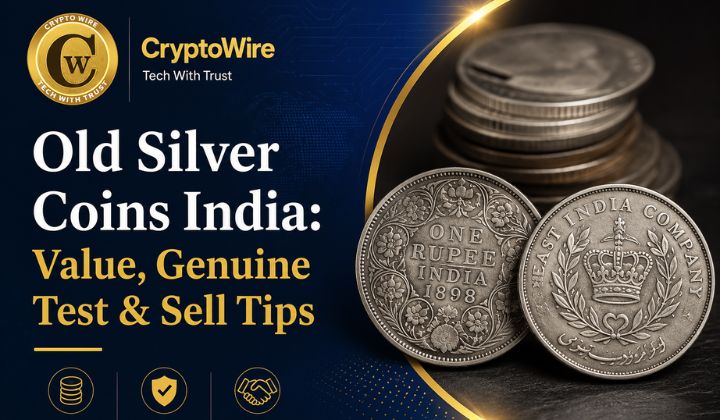
Old Silver Coin Price 2026: Worth, Value & Selling Guide
Quick Answer
Old silver coins are worth their silver (bullion) value plus a collector premium that depends on rarity, year, mint mark and condition. Common British India silver rupees fetch a few hundred to a few thousand rupees, while rare dates such as the 1939 and 1911 Pig rupee can command ₹1.5 lakh to ₹10 lakh. Sale within India is legal.
Key Takeaways
- Two values in one coin: Every old silver coin carries a melt (bullion) value and a numismatic (collector) premium. Rarity, grade and demand decide which dominates.
- Old silver coin price tracks the metal: As of mid-June 2026, silver in India trades roughly ₹247–₹265 per gram (about ₹2.65–₹2.97 lakh per kg), setting the floor under any genuine silver coin.
- The rarest pieces are dated: The 1939 One Rupee (George VI), the 1911 ‘Pig’ Rupee and East India Company rupees are India’s most prized silver issues.
- Authentication matters: Magnet, weight, dimension and ping tests filter out most fakes; high-value coins deserve professional XRF or dealer grading.
- Selling is legal with caveats: The RBI does not buy old coins. Coins over 100 years old cannot be exported without ASI permission, and large gains are taxable.
- Never clean an old coin: Cleaning can strip the patina and cut collector value by up to 90%.
What Are Old Silver Coins?
Old silver coins refer to historic coinage struck wholly or partly in silver from ancient and Mughal-era rupees to East India Company issues, British India coins (1835–1947) and early Republic of India silver.
The word rupee itself derives from the Sanskrit rūpya, meaning a wrought silver coin, a reminder that silver sat at the heart of Indian money for centuries.
Two layers of worth coexist in any such coin. The first is intrinsic: the silver content, valued at the live bullion rate. The second is numismatic: the premium collectors pay for scarcity, history and condition.
A worn, common coin trades close to its metal value; a rare date in mint state can sell for many multiples of it.
Why Old Silver Coins Hold Value
Old silver coins blend three demand drivers that rarely move together, which is part of their appeal:
- Precious-metal floor. Silver is both a safe-haven asset and an industrial metal used in solar panels, EVs and electronics, supporting long-run demand.
- Historical scarcity. Many issues were melted notably during the World Wars leaving few survivors and pushing up collector premiums.
- Cultural and collector demand. A growing base of Indian and global numismatists, plus younger investors treating coins as alternative assets, keeps the market liquid.
How Much Are Old Silver Coins Worth?
There is no single number value is a range set by the coin’s silver weight plus its collector premium. As a rule of thumb:
- Common British India silver rupees and half-rupees: typically, a few hundred to a few thousand rupees, depending on year and wear.
- Scarce dates and mint varieties: tens of thousands of rupees.
- Rarities and error coins: ₹1 lakh to ₹10 lakh, occasionally more at auction.
Factors That Determine Old Silver Coin Price
Factor | Why It Matters | Effect on Price |
Silver content & purity | Sets the bullion floor (e.g., 0.917 vs. quaternary 0.500 silver) | Higher purity = higher base value |
Rarity / mintage | Fewer surviving coins means stronger collector competition | Often the single biggest premium driver |
Condition (grade) | Graded Poor to Uncirculated (UNC); patina preserved | UNC can be 5–10x a worn example |
Year & mint mark | Certain years and mints (Bombay ‘B’, Calcutta) are scarcer | Specific dates command large premiums |
Mint errors | Off-centre strikes, missing mint marks, design flaws | Can multiply value sharply |
Market demand | Collector and auction interest shifts over time | Sets the realised, not just listed, price |
Expert tip
Numismatic dealers warn that cleaning a coin can reduce its value by as much as 90%. Collectors prefer original surfaces store coins in inert holders and never polish them.
How Do I Check the Current Price of Old Silver Coins?
Checking an old silver coin price is a two-step calculation:
Find the live silver rate, then add the collector premium.
- Get the live silver rate. Use daily-updated trackers such as Goodreturns, ClearTax, BankBazaar or BusinessToday for the per-gram and per-kg price in your city.
- Estimate the melt value. Multiply the coin’s silver weight by its purity, then by the live rate. A British India rupee holds roughly 10–11 g of silver.
- Add the numismatic premium. Cross-check recent sold listings on numismatic platforms and auction results, or a printed reference such as the Standard Catalog of World Coins.
- Confirm with a professional. For anything potentially rare, get a dealer or numismatist appraisal before selling.
Live Silver Price Reference – Mid-June 2026
Unit | Approx. Price (INR) | Notes |
1 gram | ₹247 – ₹265 | Varies by source, city and purity |
10 grams | ₹2,470 – ₹2,650 | Roughly one British India rupee’s silver |
1 kilogram | ₹2.65 – ₹2.97 lakh | Delhi quoted near ₹2.97 lakh on 1 June 2026 |
Note: Silver is volatile. In early 2026 prices swung sharply Delhi saw intra-month highs above ₹4 lakh/kg in January before settling lower. Always verify the rate on the day you buy or sell.
Which Old Silver Coins Are the Most Valuable?
India’s numismatic heritage spans empires, and a handful of silver issues are the holy grail for collectors. The table below summarises the most sought-after old silver coins and their typical auction ranges.
Values are indicative and condition-dependent.
Coin | Era / Ruler | Why It’s Prized | Typical Range (INR) |
1939 One Rupee | British India – George VI | Last high-purity (0.917) silver rupee before wartime melting; ‘Rs’ variety is rarest | ₹1.5 – 10 lakh |
1911 ‘Pig’ Rupee | British India – George V | Elephant on the robe resembled a pig; recalled, famous error coin | ₹2 – 5 lakh |
1835 Silver Rupee | East India Company – William IV | Early Company issue, historically significant | ₹1.5 – 4 lakh |
1918 One Rupee (Bombay) | British India – George V | Scarce due to WWI silver shortage and melting | ₹1 – 2 lakh |
1947 One Rupee | British India – George VI | Last year of British-issued circulating coins; Calcutta strike rarer | ₹500 – 8,000+ |
1970 FAO 10 Rupee | Republic of India | 80% silver commemorative; ‘Food for All’ cause | ₹25,000 – 1 lakh |
Mughal / Shah Alam II rupees | Mughal & Princely States | Ancient and Mughal silver prized by serious collectors | Varies widely |
Many 1939 rupees were withdrawn and melted during World War II, which is precisely why surviving examples carry such steep premiums today.
How Can I Identify Genuine Old Silver Coins?
Counterfeits have multiplied as silver prices have risen, so authentication is essential. No single test is conclusive a coin should pass several before you trust it.
Start with simple, non-destructive checks:
Test | What to Do | Genuine Silver Result |
Magnet test | Hold a strong neodymium magnet near the coin | Silver is non-magnetic; any pull suggests a fake |
Weight & dimensions | Use a digital scale and caliper vs. published specs | Must match the standard for that coin closely |
Ping / ring test | Gently tap with another metal object | A clear, sustained bell-like ring (silver resonates ~6,145 Hz) |
Ice / thermal test | Place an ice cube on the coin | Silver’s high conductivity melts it quickly |
Visual inspection | Check mint marks, edge reeding, font and patina under a loupe | Sharp detail; natural greyish patina, no ‘COPY’ stamp |
XRF analysis | Professional X-ray fluorescence at a dealer | Exact metal composition, non-destructive |
Caution: The magnet test only rules out magnetic fakes sophisticated counterfeits use non-magnetic alloys, and some are even struck on correct-weight silver planchets.
For high-value coins, professional grading is the safest route.
Where Can I Sell Old Silver Coins in India?
Sellers have both online and offline channels. Listing across more than one increases visibility and helps you benchmark a fair old silver coin price.
Online Platforms
- Dedicated numismatic marketplaces: CoinBazaar, Tezbid, Scoins India and similar sites connect you with genuine collectors.
- General marketplaces: OLX, Quikr, IndiaMart and eBay reach a wide audience — verify buyers carefully.
- Collector communities: Numismatic groups on social media and forums help with valuation and buyers.
Offline Options
- Registered coin dealers and showrooms in metros such as Delhi, Mumbai and Kolkata.
- Auction houses (for example, Rajgor’s and other established numismatic auctioneers) for rarer pieces.
- Coin exhibitions, fairs and collector association shows.
Legal & Tax Aspects of Selling Old Silver Coins
Selling genuine, non-circulating old coins is legal in India, but a few rules apply:
- RBI does not buy coins. In public notices (including August 2021), the Reserve Bank of India clarified it neither buys nor sells old coins and warned against websites falsely claiming RBI approval.
- Antiquities Act, 1972. Coins are excluded from compulsory registration, so you may hold any number freely. However, items over 100 years old cannot be exported without permission from the Director General, Archaeological Survey of India (ASI).
- Courts back collector trade. In Jitendra Singh Yadav vs Union of India (2017), the Madhya Pradesh High Court held that selling genuine, non-demonetised currency above face value is lawful private trade.
- Tax and payments. Substantial gains may attract capital-gains or income tax; cash receipts above ₹2 lakh can invite penalties, so prefer bank transfers and keep records.
Benefits and Risks of Old Silver Coins as an Investment
Benefits | Risks |
Tangible asset with a silver bullion floor | Counterfeits are widespread — authentication is essential |
Potential collector premium far above metal value | Liquidity can be slow for niche pieces |
Hedge against inflation and currency weakness | Silver prices are volatile in the short term |
Portable, durable store of value with cultural appeal | Grading and pricing require expertise; mispricing is easy |
Growing, increasingly digital numismatic market | Export limits and tax rules add friction for large sales |
Future Outlook for Old Silver Coins
The Indian numismatic market is widening. Auction records for rare Indian currency keep climbing, younger investors are treating coins as alternative assets, and digital platforms are giving sellers global reach. At the same time, silver’s dual role as a monetary hedge and an industrial metal driven by solar, EV and electronics demand underpins the bullion value that anchors every coin.
The likely trajectory: rising premiums for genuine, well-documented rarities, and steady demand for common silver coins tied to the metal price.
For sellers, the winning formula is unchanged authenticate properly, preserve original condition, document provenance, and sell through reputable channels.
Frequently Asked Questions (FAQs)
Q: How much are old silver coins worth?
A: It depends on the silver content plus a collector premium for rarity, condition, year and mint mark. Common British India silver rupees usually fetch a few hundred to a few thousand rupees, while rare dates such as the 1939 or 1911 rupee can reach ₹1.5–10 lakh. The live silver rate (about ₹247–₹265 per gram in mid-June 2026) sets the bullion floor.
Q: How do I check the current price of old silver coins?
A: First find the live silver rate from a daily tracker (Goodreturns, ClearTax, BankBazaar). Multiply the coin’s silver weight by its purity and the rate to estimate melt value, then add the collector premium by comparing recent sold listings, auction results or a catalogue. Confirm anything rare with a dealer appraisal.
Q: Where can I sell old silver coins in India?
A: Online via numismatic marketplaces (CoinBazaar, Tezbid, Scoins India) or general sites (OLX, eBay, IndiaMart), and offline via registered coin dealers, auction houses and coin fairs in cities like Delhi, Mumbai and Kolkata. Note that the RBI does not buy old coins ignore any site claiming otherwise.
Q: How can I identify genuine old silver coins?
A: Use several tests together: silver is non-magnetic, should match the standard weight and dimensions, produces a clear sustained ring when tapped, and melts ice quickly. Inspect mint marks, edge reeding and patina under a loupe. For valuable coins, get professional XRF testing or dealer grading.
Q: Which old silver coins are the most valuable?
A: Among Indian issues, the 1939 One Rupee (George VI), the 1911 ‘Pig’ Rupee (George V) and early East India Company rupees rank highest, with rarities reaching ₹1.5–10 lakh. Mint errors, scarce mint marks and uncirculated condition push prices higher still.
Stay informed with the latest trends in Crypto market, Web3, blockchain innovation, and cybersecurity updates at CryptoWire
Disclaimer
This article is for informational and educational purposes only and is not investment, legal or tax advice. Coin values are indicative and fluctuate with the silver market and collector demand. Verify the live silver price and consult a qualified numismatist or advisor before buying or selling.
CryptoWire is not affiliated with the Reserve Bank of India the RBI does not buy or sell old coins.
Sources:
- Wikipedia – Coins of British India — https://en.wikipedia.org/wiki/Coins_of_British_India
- AstaGuru – Top 10 Most Valuable Indian Coins — https://www.astaguru.com/blogs/top-10-most-valuable-indian-coins-rarest-list-that-enthralls-collectors-515
- Rajgor’s Auctions – Statutory / Antiquities note — https://rajgors.com/statutory.aspx
- Dazzle Monk – Is Selling Coins & Banknotes Legal in India — https://dazzlemonk.com/is-selling-coins-and-banknotes-legal-in-india/
- Angel One – Selling Old Banknotes and Coins in India — https://www.angelone.in/news/economy/can-you-sell-old-banknotes-and-coins-in-india
- CSN Mint – How to Tell If a Silver Coin Is Real or Fake — https://csnmint.com/blog/how-to-tell-if-a-silver-coin-is-real-or-fake/