What is Crypto Vesting? Meaning, Types, and Why It Matters in 2026
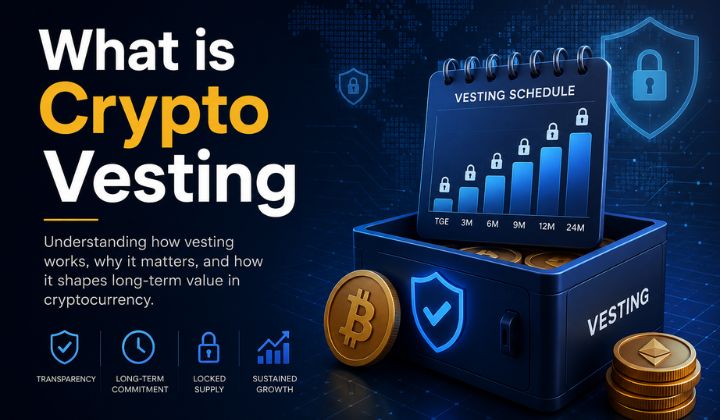
Crypto vesting is the process of releasing a projects token gradually over a fixed period instead of all at once. It locks allocations held by founders, teams, and early investors so they cannot sell immediately after launch.
Vesting controls circulating supply, reduces sell pressure, and aligns insiders with a project’s long-term success, making it a core pillar of tokenomics design.
Quick Answer
Crypto vesting is a time-based lockup written into a token’s smart contract or distribution plan. Allocated tokens unlock on a preset schedule, typically through a cliff (one large release after a waiting period) or linear vesting (small, regular releases). Once unlocked, tokens enter circulating supply and can be traded.
Key Takeaways
- Vesting releases locked tokens to teams, investors, and communities over months or years.
- Common structures include cliff, linear, non-linear, and milestone-based schedules.
- Large unlocks add sell pressure; trackers flagged over $6 billion in unlocks in March 2026, about triple the monthly norm.
- Team and investor unlocks carry higher sell risk than community allocations.
- CoinMarketCap, CryptoRank, DropsTab, and Tokenomist track unlock calendars in advance.
What Is Crypto Vesting and How Does It Work?
When a project launches its token at a Token Generation Event (TGE), only a fraction of total supply is tradable. The rest, held by the team, private investors, advisors, and treasury, sits under vesting rules.
A typical structure pairs a six-to-twelve-month cliff with linear vesting over two to four years. Smart contracts on chains like Ethereum and Solana often enforce these schedules automatically, making them verifiable on-chain.
Types of Crypto Vesting Schedules
Vesting Type | How It Works | Market Impact | Common Use |
Cliff vesting | Tokens stay fully locked until a set date, then a large batch releases at once | Sharp supply increase; higher short-term volatility | Early investors, private sale rounds |
Linear vesting | Tokens release in equal amounts daily, monthly, or quarterly | Gradual supply growth; smoother price behaviour | Team, advisors, long-term backers |
Non-linear vesting | Uneven releases at varying rates and intervals | Impact depends on timing of larger tranches | Ecosystem funds, treasuries |
Milestone-based | Tokens unlock when development or adoption targets are met | Ties supply to delivery; harder to predict | Founders, development teams |
Why Crypto Vesting Matters for Investors
Vesting makes dilution predictable. If insiders could dump their full allocation at listing, retail buyers would absorb the losses, a pattern behind many ICO-era failures.
A disciplined schedule signals that founders and venture backers are committed beyond launch, and it lets traders anticipate exactly when new supply will hit the market.
Crypto Vesting in 2026: Current Market Relevance
Unlock events remain a major market catalyst this cycle. March 2026 was flagged as the year’s largest monthly unlock wave, with over $6 billion in tokens entering circulation across projects such as Jupiter (JUP) and Aptos (APT).
July 2026 brings events for Pump.fun (PUMP) on Solana, Worldcoin (WLD), and Plasma (XPL).
Worldcoin shows how schedules can evolve: it extended vesting from three to five years, spreading roughly 80% of tokens originally due by July 2026 out to 2028. Exchanges like KuCoin and platforms such as CoinGecko and CoinGlass now publish unlock calendars as standard research tools.
What Are the Risks of Token Vesting and Unlocks?
Vesting reduces but does not remove risk. Cliff unlocks exceeding 5% of circulating supply can trigger sharp corrections if recipients sell, and insider unlocks historically see more selling than community distributions. Schedules can also be amended, and unlock data describes supply only, not demand. In weak markets, even routine linear unlocks can amplify volatility.
FAQ: Crypto Vesting Explained
What is a cliff in crypto vesting?
A cliff is a waiting period after the TGE during which nothing unlocks. Once it ends, a large batch releases and regular vesting begins.
Is a token unlock bullish or bearish?
It depends. Insider unlocks often add sell pressure, while tokens flowing to ecosystem growth or long-term partners can be neutral or constructive.
How is vesting different from a token unlock?
Vesting is the rulebook governing how tokens are earned over time; an unlock is the specific moment vested tokens become tradable.
Where can I track crypto vesting schedules?
CoinMarketCap, CryptoRank, DropsTab, Tokenomist, CoinGecko, and CoinGlass publish token unlock and vesting calendars.
Do all cryptocurrencies have vesting?
No. Fair-launch assets like Bitcoin have none, while most venture-backed tokens on Ethereum, Solana, and other chains use structured schedules.
What Investors Should Watch Next
Watch each unlock’s size relative to circulating supply, who receives the tokens, and whether recipients move them to exchanges.
High-impact events for Celestia (TIA), ZKsync (ZK), EigenLayer (EIGEN), and Pyth Network (PYTH) will test market absorption through late 2026.
Reading a project’s vesting chart before buying remains one of the simplest risk checks available.
Stay informed with the latest trends in Crypto market, Web3, blockchain innovation, and cybersecurity updates at CryptoWire.
Disclaimer: This article is for informational and educational purposes only and is not investment advice. Cryptocurrency is volatile and high-risk. Always do your own research and consult a qualified financial professional before investing.