Key Highlights
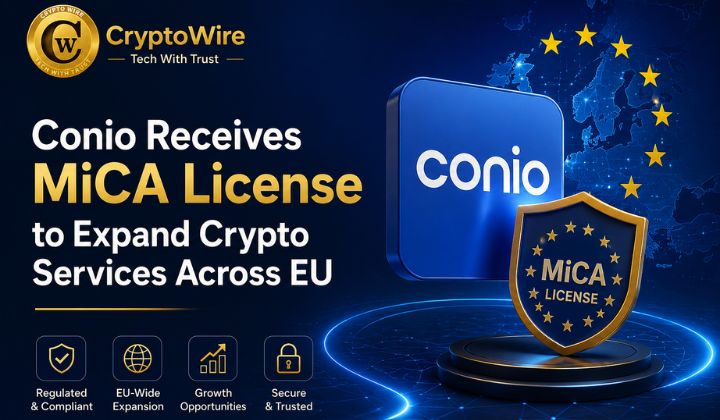
- Italian fintech Conio has obtained a MiCA license, enabling it to offer regulated crypto custody, transfer, and placement services across the European Union.
- The company received Crypto-Asset Service Provider (CASP) authorization from Italian regulators ahead of the EU’s July 1, 2026 MiCA compliance deadline.
- MiCA establishes a unified regulatory framework for digital assets, designed to strengthen investor protection and improve market transparency.
- Conio plans to broaden its business beyond retail crypto offerings by providing white-label digital asset infrastructure to banks, fintech companies, and institutional clients.
Italian fintech Conio has secured authorization under the European Union’s Markets in Crypto-Assets (MiCA) framework, marking another milestone in the growing institutionalization of digital assets across Europe.
Backed by financial giants Poste Italiane and Banca Generali, Conio announced that it has received Crypto-Asset Service Provider (CASP) authorization in Italy, according to a Reuters report.
The approval allows the company to offer regulated cryptocurrency custody, transfer, and placement services throughout the EU under a single regulatory regime.
The authorization follows a joint review conducted by Italy’s two key financial watchdogs, the Bank of Italy and Consob.
With the license in place, Conio gains access to the broader European market without needing separate approvals in individual member states one of the core advantages introduced by MiCA.
The regulatory framework was created to bring consistency to Europe’s fragmented digital asset market. For years, crypto firms faced a patchwork of national regulations that often complicated expansion plans.
MiCA changes that dynamic by introducing common standards for licensing, compliance, investor protection, and operational oversight across the bloc.
Conio Eyes Institutional Expansion
The approval arrives just ahead of the EU’s July 1, 2026 deadline, after which crypto companies lacking the required authorization will no longer be able to provide regulated services within the region.
That deadline has triggered a wave of licensing activity among exchanges, custodians, brokers, fintech firms, and traditional financial institutions seeking to secure their place in Europe’s regulated crypto market.
According to Conio CEO Christian Miccoli, the MiCA license supports the company’s broader strategy of becoming a trusted infrastructure partner for financial institutions looking to integrate digital assets into regulated investment offerings.
Miccoli also indicated that Conio intends to deepen its involvement in tokenization initiatives and blockchain-based financial infrastructure as demand for compliant digital asset solutions continues to grow.
Industry observers increasingly view tokenization as one of the most promising opportunities emerging from the next phase of blockchain adoption, particularly among banks and asset managers.
Moving Beyond Retail Crypto Services
While Conio initially built its reputation through retail-focused cryptocurrency products, the company is now expanding into business-to-business services.
Its next phase of growth will include providing white-label digital asset infrastructure to banks and fintech firms seeking crypto capabilities without building the technology stack internally.
The company also plans to support institutional and corporate clients exploring tokenized assets, blockchain-powered financial products, and other regulated digital asset services.
Conio’s approval reflects a broader shift taking place within Italy’s digital asset sector. As regulatory clarity improves, more traditional financial institutions are entering the market rather than remaining on the sidelines.
Earlier this year, Banca Sella became the first Italian bank to receive authorization under the MiCA framework. The bank also joined the Qivalis consortium, a group of financial institutions working on a MiCA-compliant euro stablecoin project.
The latest approval highlights how MiCA is reshaping Europe’s crypto landscape. Firms that secure regulatory authorization early are positioning themselves to capture institutional demand as banks, fintech companies, and asset managers increasingly seek compliant pathways into digital assets.
Want to Earn Jio Coin: Learn Here step by Step
Stay informed with the latest trends in Crypto market, Web3, blockchain innovation, and cybersecurity updates at CryptoWire