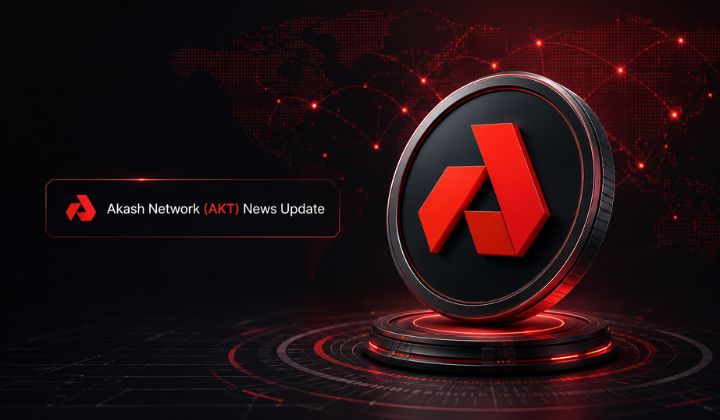
Akash Network Upgrade News: What Mainnet 18 Means for AKT
Akash Network (AKT) is trading near $0.61 as of June 13, 2026, after a volatile first half of the year. Messari’s Q1 2026 data shows active leases rose 27% even as lease revenue fell 45%, while the network advances an AKT token-burn model and a planned migration away from its Cosmos chain.
What Is Akash Network?
Akash Network is a decentralized cloud computing marketplace built on the Cosmos SDK, founded by Greg Osuri and Adam Bozanich in 2018 and launched on mainnet in 2021.
It lets data centers and GPU owners rent out spare compute to developers, often well below the cost of AWS, Google Cloud, or Microsoft Azure.
AKT is the network’s native token, used for staking, governance, and settling deployment leases. It positions Akash within the decentralized physical infrastructure (DePIN) sector.
Usage Climbs, but Revenue Slips
Messari’s Q1 2026 report describes a network growing in activity but not yet in income. Active leases rose 27.1% quarter-over-quarter to 43,540, signalling more workloads on the platform.
Lease revenue, however, fell about 45% to roughly $253,250, down from around $460,510 in Q4 2025. That gap between usage and revenue has become the central question for analysts tracking AKT.
It suggests cheaper or smaller workloads are lifting lease counts without matching dollar value. For context, Akash reported $3.15 million in 2025 annual revenue, up 128% year over year.
The Burn-Mint Equilibrium Model
In March 2026, Akash activated its Burn-Mint Equilibrium (BME) model under proposal AEP-76. The mechanism is designed to burn AKT as network usage rises, tying token supply more directly to real demand.
Per Messari, AKT rallied roughly 41.6% in Q1 2026, with much of the move concentrated around the BME activation date of March 23. The model’s deflationary promise ultimately depends on revenue catching up to lease volume.
A Planned Chain Migration
Akash is also weighing a major structural change. Founder Greg Osuri has outlined plans to deprecate the project’s sovereign Cosmos SDK chain and adopt a shared-security model from an established Layer 1, citing capital inefficiency from AKT staking and high operational overhead.
The network has issued a request for proposals to potential security providers. Such a migration could reduce costs, but it introduces execution risk and uncertainty around AKT’s staking role.
Why It Matters
The DePIN sector has drawn fresh interest as AI demand strains centralized GPU supply. Akash’s pitch is straightforward: cheaper, permissionless compute for AI training and inference, with deployments it says run materially below traditional cloud prices.
Recognition has followed. AKT was added to Grayscale’s AI-focused sector index in May 2025 and Coinbase’s Coinbase 50 Index in June 2025. Even so, the token trades roughly 90% below its $8.08 all-time high.
What Investors Should Watch Next
Whether lease revenue begins converging with rising lease counts in upcoming Messari reports the key test of the BME model.
Progress and the final provider selection in the shared-security migration, including any changes to AKT’s staking utility.
Delivery of roadmap items such as virtual machine support and confidential computing, plus momentum around the Akash annual conference in San Francisco this October.
Conclusion
Akash Network enters mid-2026 with a credible product and a clear narrative, but an unresolved tension between growing usage and falling revenue.
The BME model and a potential chain migration are ambitious bets on long-term sustainability. For now, AKT’s trajectory hinges on whether real economic activity can validate those design choices.
Disclaimer
This article is for informational purposes only and does not constitute financial or investment advice. Cryptocurrency markets are volatile readers should do their own research before making decisions. Data cited reflects publicly reported figures as of mid-June 2026 and may have changed.