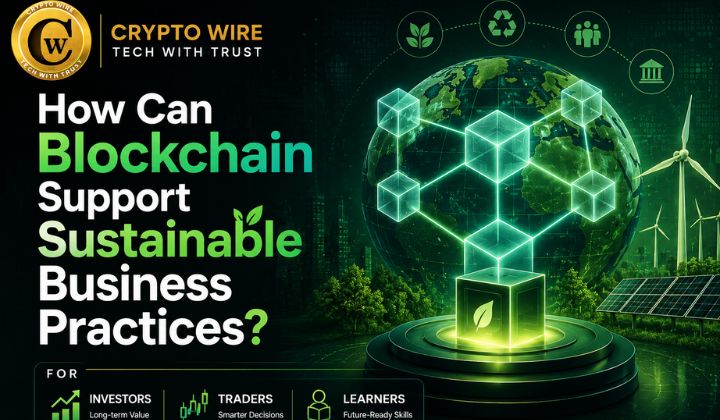
Blockchain can support sustainable business practices by creating transparent, tamper-resistant records of products, emissions, resource usage, and supplier activities.
This allows companies to verify sustainability claims, improve supply chain traceability, reduce fraud, automate ESG reporting, and strengthen accountability across global operations, making sustainability initiatives more measurable and trustworthy.
Key Takeaways
- Blockchain improves supply chain transparency and product traceability.
- Companies can track carbon emissions and sustainability metrics more accurately.
- Smart contracts can automate compliance and ESG reporting.
- Blockchain helps reduce greenwashing through verifiable records.
- Sustainable sourcing becomes easier to verify across complex supply chains.
How Can Blockchain Improve Supply Chain Sustainability?
Supply chains are one of the most impactful areas where blockchain supports sustainability.
A blockchain ledger creates an immutable record of every transaction, movement, and certification associated with a product.
According to the World Economic Forum (WEF), blockchain can help bring greater standardization, alignment, and transparency across fragmented global supply chains.
This visibility enables businesses to verify sourcing practices, monitor environmental impact, and identify inefficiencies that contribute to waste.
As Nadia Hewett, Project Lead for Blockchain and Digital Assets at the World Economic Forum, noted:
“Blockchain presents a technology promise that would have far-reaching implications for global trade and supply chains.”
How Does Blockchain Help Reduce Greenwashing?
Greenwashing occurs when companies make sustainability claims that cannot be verified. Blockchain addresses this challenge by creating a permanent and auditable record of environmental and social impact data.
For example, companies can record certifications related to sustainable sourcing, renewable energy usage, or fair-trade practices on a blockchain network.
Stakeholders can independently verify these claims rather than relying solely on company disclosures.
According to the EU Blockchain Observatory, blockchain-based transparency systems are increasingly being explored to improve supply chain accountability and traceability.
Can Blockchain Support Carbon Tracking and Climate Goals?
Yes. Blockchain can improve the integrity and transparency of carbon accounting and carbon credit markets.
The World Economic Forum has highlighted blockchain’s potential to create more transparent and efficient carbon markets by improving the traceability of environmental assets and climate finance initiatives.
This can help businesses accurately track emissions reductions and avoid double counting of carbon credits.
Organizations pursuing net-zero targets can use blockchain to create verifiable records of carbon emissions, renewable energy purchases, and sustainability initiatives.
How Can Blockchain Reduce Waste and Improve Resource Efficiency?
Blockchain enables real-time visibility across production and distribution networks. Better visibility helps companies identify bottlenecks, excess inventory, and inefficiencies that contribute to waste.
In the food industry, blockchain-based traceability systems can track products from origin to consumer.
According to the World Economic Forum, approximately one-third of all food produced globally around 1.3 billion tonnes annually is lost or wasted. Improved traceability can help reduce this waste while improving food safety and sustainability outcomes.
Similarly, digitalized and transparent supply chains can reduce unnecessary inventory, lower resource consumption, and support more efficient logistics operations.
What Role Do Smart Contracts Play in Sustainable Business Practices?
Smart contracts are self-executing agreements stored on a blockchain. They automatically perform actions when predefined conditions are met.
Businesses can use smart contracts to:
- Verify sustainability certifications automatically.
- Release payments only when environmental standards are met.
- Monitor supplier compliance.
- Automate ESG reporting processes.
- Incentivize sustainable behavior across supply chains.
By reducing manual verification and administrative overhead, smart contracts improve both operational efficiency and sustainability governance.
What Are the Limitations of Using Blockchain for Sustainability?
Blockchain is not a standalone solution for sustainability challenges.
Researchers have noted that transparency alone does not solve environmental or social issues.
Data accuracy remains critical because blockchain can only verify information that is entered correctly. Poor-quality input data can still lead to misleading outcomes.
Additionally, governance, stakeholder collaboration, and regulatory oversight remain essential for successful sustainability initiatives.
FAQ
Why is blockchain considered useful for sustainability?
Blockchain provides transparent, immutable records that help businesses verify sustainability claims, track environmental impact, and improve accountability across supply chains. This reduces information gaps and increases trust among customers, regulators, and investors.
How does blockchain improve supply chain transparency?
Blockchain records every transaction and movement of goods in a shared ledger. This creates an auditable history that helps companies trace products back to their origin and verify ethical sourcing practices.
Can blockchain help with ESG reporting?
Yes. Blockchain can automate data collection and verification processes, making ESG reporting more accurate, transparent, and auditable while reducing manual reporting errors.
How does blockchain support carbon credit markets?
Blockchain improves traceability and transparency in carbon credit transactions, helping organizations verify environmental claims and reduce the risk of double counting.
What industries benefit most from blockchain sustainability solutions?
Food, agriculture, manufacturing, logistics, energy, fashion, and mining sectors benefit significantly because they rely on complex supply chains where traceability and compliance are critical.
Does blockchain automatically make a business sustainable?
No. Blockchain is an enabling technology. Sustainability outcomes still depend on accurate data, effective governance, responsible business practices, and stakeholder collaboration.
Can blockchain help reduce food waste?
Yes. Enhanced traceability allows businesses to monitor food products throughout the supply chain, identify inefficiencies, improve recalls, and reduce waste.
The FAO estimates that around 1.3 billion tonnes of food are lost or wasted annually, making traceability a valuable sustainability tool.