
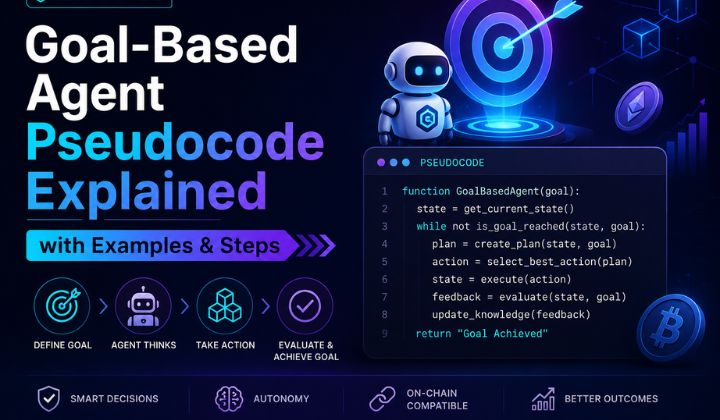
Goal-based agent pseudocode describes how an AI agent perceives its environment, formulates a goal, searches for a sequence of actions, and executes them step by step. Rooted in Russell and Norvig’s model, it adds planning and search to reflex behavior letting the agent decide which actions actually lead to its desired goal state.
Key Takeaways
- A goal-based agent chooses actions by reasoning about which outcomes reach a defined goal, not just by reacting to inputs.
- The canonical goal-based agent pseudocode is the SIMPLE-PROBLEM-SOLVING-AGENT loop: update state, formulate goal, search, then act.
- It is more flexible than reflex agents because goals and knowledge can be updated without rewriting rules.
- Modern frameworks such as ReAct, LangGraph, and CrewAI extend this 1995 architecture to today’s LLM agents.
What Is a Goal-Based Agent?
A goal-based agent is an AI agent that selects actions to achieve an explicit objective, or goal state. Russell and Norvig classify it as Level 3 in their five-tier agent hierarchy above simple reflex and model-based agents, and below utility-based and learning agents.
Unlike a reflex agent that maps percepts directly to actions, a goal-based agent uses search and planning to evaluate how candidate actions move it toward its goal.
Why Goal-Based Agents Matter
Although a goal-based agent appears less efficient than a hard-coded reflex agent, Russell and Norvig note it is far more flexible: because the knowledge supporting decisions is represented explicitly, behavior changes simply by updating the goal no rule-by-rule rewrite needed.
This makes the design the conceptual backbone of route planners, robotics, and autonomous LLM agents.
Goal-Based Agent Pseudocode (Step by Step)
The reference goal based agent pseudocode below mirrors the SIMPLE-PROBLEM-SOLVING-AGENT from aimacode/aima-pseudocode, the official companion to Artificial Intelligence: A Modern Approach.
function GOAL-BASED-AGENT(percept) returns an action
persistent: state, the agent’s model of the world
goal, the desired objective, initially null
seq, an action sequence, initially empty
state <- UPDATE-STATE(state, percept)
if seq is empty then
goal <- FORMULATE-GOAL(state)
problem <- FORMULATE-PROBLEM(state, goal)
seq <- SEARCH(problem)
if seq = failure then return a null action
action <- FIRST(seq)
seq <- REST(seq)
return action
In plain terms, the agent (1) updates its world state from the new percept, (2) formulates a goal and problem, (3) searches for an action sequence that reaches the goal, and (4) executes that plan one action per cycle, replanning when the sequence is exhausted.
Pseudo Code for the Agent-Based Model
In simulation contexts, pseudo code for the agent-based model wraps the same perceive decide act logic inside a population loop, where many goal-seeking agents update each simulation tick:
for each tick in simulation:
for each agent in population:
agent.perceive(environment)
action = agent.decide(goal) # search / planning
agent.act(action, environment)
update(environment)
Agent Types Compared
Agent Type | Decision Basis | Key Limitation |
Simple Reflex | Condition-action rules | No memory or goals |
Model-Based | Internal world state | Reacts, but goal-blind |
Goal-Based | Search + planning to a goal | Costlier to compute |
Utility-Based | Maximizes a utility score | Needs utility function |
Benefits and Risks
Benefits | Risks |
Flexible—update the goal, not the code | Search can be computationally expensive |
Explicit, explainable reasoning | Poorly defined goals cause unsafe actions |
Adapts to changing environments | Planning fails if the world model is wrong |
Impact and Future Outlook
The 30-year-old goal-based architecture now underpins production LLM agents. The ReAct framework (Yao et al., 2022) interleaves reasoning and action and reported a 34% improvement on ALFWorld and 10% on WebShop over single-pass prompting.
Frameworks like LangGraph and CrewAI implement goal-driven loops at scale, signaling that goal-based agent pseudocode remains the foundation of the agentic AI era.
Frequently Asked Questions (FAQs)
What is goal-based agent pseudocode?
It is a structured outline of how a goal-based agent works: it updates its state from a percept, formulates a goal and problem, searches for an action sequence, and executes those actions one cycle at a time.
How is a goal-based agent different from a reflex agent?
A reflex agent maps percepts straight to actions using fixed rules. A goal-based agent reasons about which actions reach a goal, so its behavior changes when the goal changes no rule rewrite needed.
Who defined the goal-based agent model?
Stuart Russell and Peter Norvig formalized it in Artificial Intelligence: A Modern Approach, classifying it as the third level in their hierarchy of agent designs.
What is the difference between goal-based agent and agent-based model pseudocode?
Goal-based agent pseudocode describes one agent’s planning loop. Pseudo code for the agent-based model runs many such agents across simulation ticks to study emergent collective behavior.
Are LLM agents goal-based agents?
Yes. Modern LLM agents built with ReAct, LangGraph, or CrewAI extend the goal-based design by interleaving reasoning, planning, and action toward a user-defined goal.
Stay informed with the latest trends in Crypto market, Web3, blockchain innovation, and cybersecurity updates at CryptoWire